

The Empire Never Really Left
India won independence in 1947. But the institutions, hierarchies and systems built to serve the British Empire continue to shape the country long after the Empire itself is gone.

15 min read
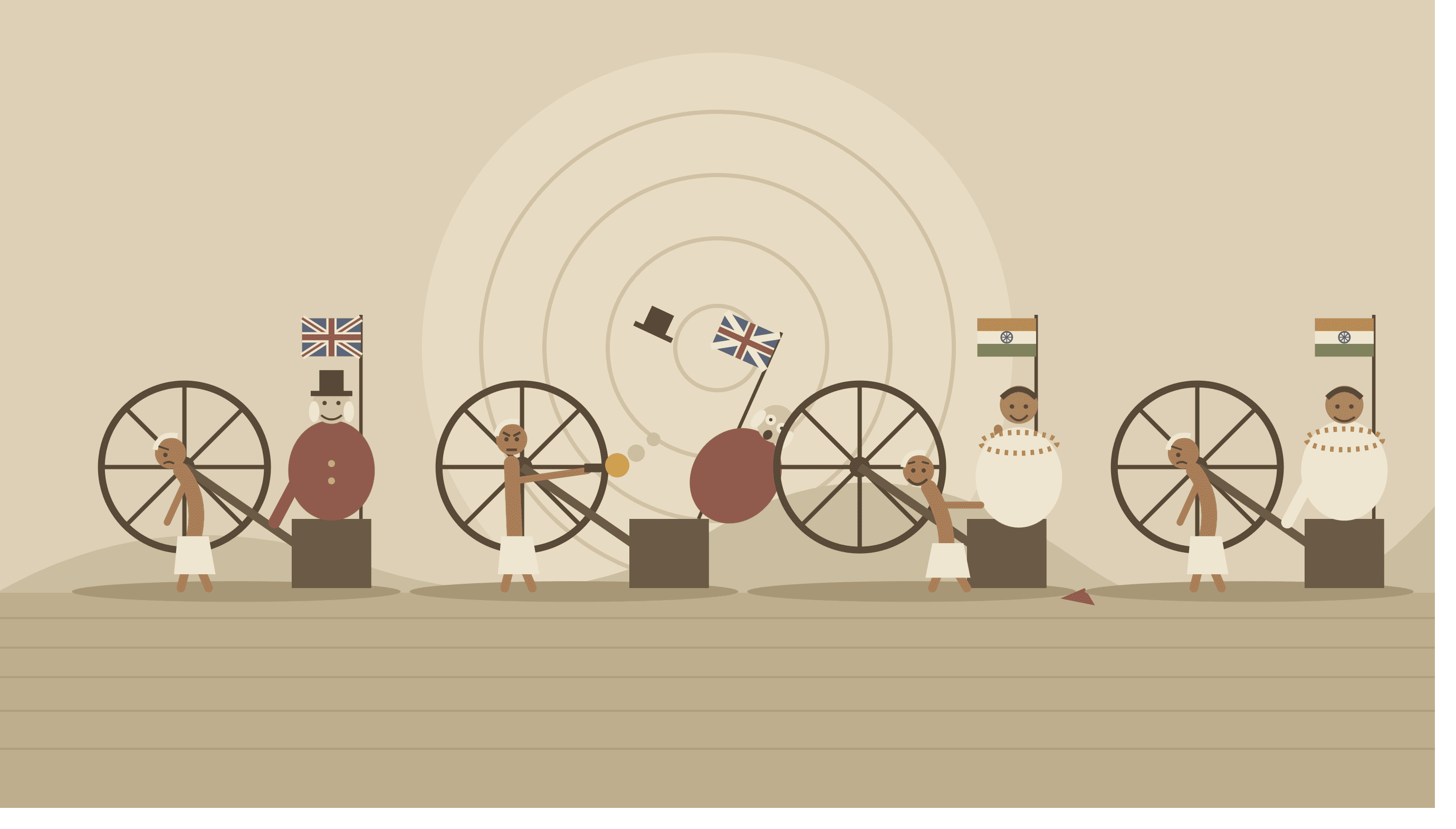
There is something peculiar about the way we remember British rule in India. We speak of the railways, the legal system, the English language, the civil services and the institutions they introduced as though they were gifts bestowed upon a country that had been waiting for someone to modernise it.
We credit them with connecting the country, introducing education, establishing administration and laying the foundations of modern governance. We inherited these systems, adapted them and continue to use many of them today. But somewhere along the way, we stopped asking a rather obvious question.
Who were these systems originally built to serve?
The British did not arrive in India to develop an independent Indian nation. They came as traders, expanded into rulers and eventually established an empire. Their economic interests, administrative priorities and political decisions were shaped by the needs of that empire. India was the territory they controlled, the resources they extracted and the population they governed. It was not the country whose future they were entrusted to protect.
This distinction matters because we have spent generations confusing the usefulness of what they left behind with the intentions behind its creation.
The machinery was never built for us
Consider the administrative structure inherited by independent India. The British developed a centralised bureaucracy that allowed a relatively small ruling establishment to administer an enormous territory, collect revenue, enforce regulations and maintain imperial authority.
The Indian Civil Service was not designed around the idea of citizens exercising control over their government. It was an elite administrative service operating within a colonial hierarchy. The district collector, for example, held considerable authority over revenue and district administration.
The police structure offers an even clearer example. The Police Act of 1861 followed the upheaval of 1857 and established a uniform system of policing under colonial authority. Its stated purpose was to reorganise the police and make it more efficient in preventing and detecting crime. But the wider historical context was the British determination to consolidate their authority after a major uprising and prevent another challenge to imperial rule.
The colonial police system operated within an administration that prioritised the preservation of imperial authority. Its structure reflected a government accountable to the British Crown rather than to the Indian population it governed.
These were not accidental characteristics. They reflected the political purpose of the institutions.
A colonial administration needed obedience, revenue collection, surveillance and control. It needed a hierarchy in which authority travelled downwards and instructions were implemented across the territory.
India became independent, but much of this administrative architecture survived. Its officers changed. Its political authority changed. Its constitutional obligations changed. Yet its institutional habits and inherited hierarchies did not vanish overnight.
The question is not whether these institutions can perform useful functions. Clearly, they can. The question is whether an institution designed to administer subjects automatically becomes suitable for serving citizens simply because its officers are now Indian.
The development we were supposed to be grateful for
The railways are perhaps the most frequently cited example of Britain's contribution to India. They connected distant regions, facilitated commerce, reduced transportation time and eventually became indispensable to the country.
But why were they built?
British commercial interests wanted access to Indian cotton, raw materials and agricultural produce. Military authorities also saw the value of a railway network that could move troops and supplies across the subcontinent. Railway development took place within this wider imperial and commercial framework.
That history should not be confused with the railways' later contribution to Indian society. In their 2023 study, Railways, Development, and Literacy in India, published in The Journal of Economic History, researchers Latika Chaudhary and James Fenske examine the relationship between railway expansion and literacy in colonial India.
Their research finds that railways had positive effects on literacy, particularly male and English literacy. They also identify the expansion of secondary and elite primary schooling as important mechanisms behind those effects.
The findings are significant. They show that railway development had consequences that extended beyond the immediate commercial and administrative interests of the colonial state. But acknowledging those consequences does not require us to rewrite the original political and economic context in which the network was developed.
The railways were useful to India. That does not mean they were originally constructed as an act of generosity towards Indians.
The same distinction applies to other colonial institutions. Courts, universities, postal networks, roads and administrative systems may have acquired enormous value after independence. But their subsequent usefulness does not retrospectively transform the intentions behind their establishment.
If someone argues that India benefited from the railways, the answer is simple: yes, the railways became valuable to India. But that is not evidence that British rule was undertaken for India's benefit.
A system can benefit a country after it has been inherited without having been created for that country's welfare.
And this is precisely where colonial nostalgia becomes misleading. We remember what survived and became useful. We conveniently overlook the circumstances under which it was created, the interests it served and the people who paid for it.
Educated Indians. Educated in what?
Perhaps one of the most consequential aspects of colonial rule was not the infrastructure it introduced, but the authority it assumed over the definition of knowledge itself.
Before the British established their educational policies, India had diverse traditions of learning. Gurukulas, pathshalas, Sanskrit institutions and specialised centres of knowledge taught philosophy, mathematics, astronomy, medicine, grammar, literature and statecraft. Knowledge was also transmitted through regional languages, professional communities and practical traditions.
These systems were not identical to modern universities, nor were they equally accessible to everyone. But the existence of different educational structures should never be confused with an absence of education.
Then came the colonial preference for English-language instruction and Western learning.
Thomas Babington Macaulay's Minute on Indian Education, dated 2 February 1835, is particularly revealing.
He wrote:
We must at present do our best to form a class of persons, Indian in blood and colour, but English in taste, in opinions, in morals, and in intellect.
He went on to describe this class as interpreters between the British and the millions they governed.
Macaulay also argued that English was more valuable to teach than Sanskrit and advocated directing colonial educational resources towards Western learning.
Consider what this meant. An Indian could possess extensive knowledge of Sanskrit philosophy, mathematics, medicine or indigenous jurisprudence and still lack the qualifications recognised by the colonial administration. English education became a route to government employment, institutional recognition and social advancement.
The issue was no longer simply what a person knew. It was whether that knowledge was recognised by the ruling establishment.
So when British officials spoke of educated Indians, who exactly were they referring to?
Indians educated in what? According to whose standards?
The colonial administration increasingly privileged a particular intellectual tradition and gave it the authority to determine what counted as formal education. This was not merely a change in the language of instruction. It was a change in the hierarchy of knowledge.
The consequences extended beyond classrooms. When a civilisation begins measuring its intellectual worth against the standards of the civilisation governing it, its relationship with its own traditions inevitably changes.
Representation, but whose representation?
The origins of the Indian National Congress make this question even more interesting.
Established in 1885, the Congress emerged through the initiative of Allan Octavian Hume, a retired British civil servant, alongside Indian political leaders and public figures. Its first session in Bombay had 72 delegates and was presided over by Womesh Chandra Bonnerjee.
The early Congress sought greater Indian participation in administration, expansion of legislative councils, opportunities in the civil services and changes to colonial policies. It initially pursued constitutional reforms within the British imperial framework rather than demanding immediate independence.
Lord Dufferin, the Viceroy, saw the usefulness of an organised political body through which educated Indians could express their views about the administration. This also gave the colonial government an organised channel through which it could understand the grievances and opinions of a section of the Indian population.
This is where we must ask: representation of whom, and by whom?
The early Congress was predominantly composed of educated professionals, lawyers, journalists and members of the emerging English-educated Indian middle class. It was not a representative sample of India's enormous and socially diverse population.
The British were not handing sovereignty to the Indian people. They were engaging with a limited group of Indians who could communicate within the political and intellectual framework recognised by the colonial administration.
That does not erase the agency of the Indian founders, nor does it diminish the Congress's later contribution to the independence movement. The organisation evolved considerably and eventually became a central force in the struggle against British rule.
But its beginnings reveal the limitations of political representation under colonial authority. Indians could petition, deliberate and demand reforms. The ultimate authority to accept or reject those demands remained with the British.
Representation within an empire was not the same as self-government.
Independence changed the authority. Did it change the machinery?
India's independence in 1947 was a monumental political achievement. The Constitution, which came into effect in 1950, established a sovereign democratic republic founded on popular authority, universal adult suffrage, fundamental rights and constitutional limitations on government.
It would be absurd to suggest that nothing changed.
But a Constitution and the administrative machinery through which it is implemented are two different things.
The Constitution defines the principles of governance, the rights of citizens and the limitations of state power. Institutions determine how those principles are carried out in everyday life.
India could replace imperial sovereignty with popular sovereignty without automatically redesigning every administrative structure inherited from British rule.
The Police Act of 1861, for example, continued to influence policing long after independence. The Indian Civil Service gave way to constitutionally recognised All India Services, including the IAS and IPS, but the inherited bureaucratic hierarchy did not disappear. Much of the legal system continued within a common-law tradition shaped during British rule.
A Constitution can guarantee equality without automatically eliminating institutional inequalities. It can establish accountability without ensuring that every public institution is transparent. It can declare citizens sovereign without automatically changing the culture of institutions accustomed to exercising authority from above.
This is not an argument against the Constitution. It is an argument against assuming that constitutional independence automatically amounts to institutional decolonisation.
The price of calling exploitation development
Before we congratulate the British for what they supposedly left India, we should remember what their rule also cost.
The economic extraction of India was not an incidental consequence of colonial administration. It was a central feature of the imperial relationship.
Dadabhai Naoroji spent much of his political life documenting what he called the drain of wealth. In Poverty and Un-British Rule in India, published in 1901, he argued that Indian revenue and resources were being transferred to Britain without an equivalent return to the Indian population.
He wrote:
The present system of government is destructive and despotic to the Indians and un-British and suicidal to Britain.
He also complained that Indians had no meaningful voice in how their revenues were spent.
This was not a criticism invented by later generations. Indians living under colonial rule were already documenting the economic consequences of imperial policy.
And the human cost cannot be reduced to an accounting exercise.
The famine of 1876–78 devastated large parts of India. According to the Indian Famine Commission's 1880 report, excess mortality in British-ruled territory during the famine period was estimated at over five million. The Commission also estimated that the number of births had fallen by around two million as a result of starvation and distress.
The colonial administration's relief policies were shaped by fiscal restraint and laissez-faire thinking, even as millions faced starvation.
Then came the Bengal famine of 1943. Estimates commonly place its death toll between 1.5 and 3 million. Wartime priorities, inflation, food distribution failures, administrative decisions and the British government's inadequate response all contributed to the catastrophe.
The causes of individual famines were complex. Drought, crop failure, war, market disruption and hoarding played their parts. But colonial policy and the decisions of those governing India cannot be separated from the disasters.
There were deaths, starvation, displacement, disease and humiliation on a staggering scale.
So when someone points to a railway line, a university or a courthouse and asks what Britain gave India, the question should be turned around.
What did India pay for it?
The existence of infrastructure does not cancel the suffering of the people who lived under the system that built it. Nor does the fact that independent India found ways to use inherited institutions compensate for the extraction and human suffering that accompanied colonial rule.
A country does not become benevolent simply because some of its infrastructure survives its departure.
The chair changes. The power remains.
There is another consequence of inherited systems that deserves attention: the concentration of power.
Imagine a powerful business group acquiring another, while ownership of a third changes hands. The names on the buildings change, the people in the boardroom change and the ownership structure changes. But the ordinary person watching from outside may experience very little difference.
The chair has changed occupants. The power attached to the chair remains.
This is the concern with political and administrative power too. A change in the ruling establishment does not automatically mean that the underlying distribution of influence has changed. The same institutional hierarchy can accommodate different political parties, different administrators and different powerful interests.
This is not to suggest that every government is identical or that democratic elections have no meaning. They do. There is a fundamental difference between a government that derives its authority from the votes of citizens and a colonial administration appointed by a foreign power.
India's elected governments possess a constitutional and electoral mandate that the British colonial government never had. Their authority comes from a political system in which Indian citizens participate as voters, not subjects of an empire.
That distinction should not be minimised. It is an achievement of independence.
But it also makes the institutional question more important, not less. The fact that an elected government operates a system does not establish that every inherited feature of that system is suitable for a sovereign democracy. Nor should the performance of any one government be confused with the historical purpose of the institutions it inherited.
The point is not to blame today's administration for every structure created under British rule. It is to recognise that the machinery has a history much older than the governments now operating it.
Neither entirely ours, nor entirely theirs
Perhaps the deepest consequence of colonial rule was the disruption of India's relationship with its own identity.
This is not to suggest that Indian identity was ever static or that Western influences have no place in modern India. Civilisations evolve through exchange, adaptation and encounter. English is now an Indian language in the sense that millions of Indians have made it part of their everyday lives. Western scientific and intellectual contributions have also become part of India's knowledge landscape.
The problem begins when adoption becomes unquestioned dependence, and when inherited standards are mistaken for universal standards of progress.
We have sometimes treated our own intellectual traditions as relics while treating imported systems as inherently modern. We have inherited administrative practices without always examining their original purpose. We have celebrated institutions without asking whose interests shaped them.
We are not required to reject everything British to reclaim our intellectual independence. Neither must we abandon everything indigenous to prove that we are modern.
But we should be able to distinguish between what we deliberately chose, what we adapted out of necessity and what we simply continued because it was already there.
The British left India in 1947. They did not take every institution, every administrative habit, every hierarchy of knowledge or every colonial assumption with them.
And perhaps that is why the word independence deserves more scrutiny than celebration alone.
The empire left. Its shadow remained.
On 23 January 1948, Winston Churchill said in the House of Commons:
For my part, I consider that it will be found much better by all parties to leave the past to history, especially as I propose to write that history myself.
The remark is revealing in its own right. Those who hold power understand the importance of how history is recorded, interpreted and remembered.
Colonial rule did not merely extract resources. It also shaped institutions, education, administrative hierarchies and the standards through which Indians were encouraged to understand progress.
That influence did not end when the Union Jack came down.
Perhaps the greatest mistake is not that we inherited colonial institutions. A newly independent country had to govern itself with the structures available to it. The mistake would be to assume that because we have continued using them, they must have been designed for our benefit.
India is independent. Its people vote, its Constitution is its own, and its governments derive their authority from its citizens. These are substantial achievements.
But independence should not make us intellectually complacent.
If the British built institutions to govern us, why do we so rarely question the assumptions embedded within them? If they defined the qualifications of an educated Indian, why do we still struggle to recognise knowledge outside the standards they privileged? If they introduced infrastructure to serve imperial interests, why do we treat its existence as proof of imperial benevolence?
The empire extracted what it could, governed for its own interests and eventually departed. India was left to make a nation out of the institutions, divisions and structures that remained.
We won the right to govern ourselves. But have we ever fully questioned the machinery through which we continue to do it?
Cover illustration: made by the author using Claude AI.
Sources
- Thomas Babington Macaulay, “Minute on Indian Education” (2 February 1835). Original document containing Macaulay's proposal for an English-educated intermediary class.en.wikisource.org
- Stephen Evans, “Macaulay’s Minute Revisited: Colonial Language Policy in Nineteenth-century India” (2002). Academic analysis of British education and language policy in colonial India.doi.org
- Agnes Cornell and Ted Svensson, “Colonial Origins of Modern Bureaucracy? India and the Professionalization of the British Civil Service” (2023). Research on the Indian Civil Service and colonial bureaucracy.doi.org
- “Orality, State Power, and the Labour of Policing in Colonial Bengal, c.1850–1947.” Past & Present. Research on colonial policing and the Police Act of 1861.academic.oup.com
- Elizabeth Kolsky, “Codification and the Rule of Colonial Difference: Criminal Procedure in British India” (2005). Research on colonial law and unequal legal structures in British India.doi.org
- “Colonial Petitions, Colonial Petitioners, and the Imperial Parliament, ca. 1780–1918.” Journal of British Studies. Research on political petitions, representation and early Indian constitutional demands.cambridge.org
- Dadabhai Naoroji, Poverty and Un-British Rule in India (1901). A foundational work examining the economic drain of wealth from India under British rule.archive.org
- The Constitution of India. The constitutional framework that established the sovereign democratic republic and came into effect on 26 January 1950.legislative.gov.in
- The Police Act, 1861. The legislation that established the colonial police framework.saslawchambers.com
- Winston Churchill, House of Commons speech, 23 January 1948. The original source of the quotation used in the article.hansard.parliament.uk
- Chaudhary, Latika, and James Fenske. “Railways, Development, and Literacy in India.” The Journal of Economic History, vol. 83, no. 4, 2023, pp. 1139–1174.cambridge.org
- Indian Famine Commission. Report of the Indian Famine Commission, 1880.archive.org
Enjoyed this? Get new stories in your inbox.
One email on Mondays with the week's new stories. Free, and one click to unsubscribe.
About the writer

Content Writer | Fiction & Script Writer
I'm a writer working across digital content, fiction, and scriptwriting. My experience includes AI and technology articles, SaaS copy, email sequences, published sports writing, dramatic scripts, and ongoing fantasy fiction projects. I enjoy developing engaging stories, compelling characters, natural dialogue, and narratives that keep readers invested. I also write clear, research driven articles that make complex subjects accessible. From blog posts and marketing copy to fiction and scripts, I adapt my writing to the audience, format, and purpose of each project.
Writes about Research, Opinion, Other, Science