

Can Vastu Shastra Be Explained Through Environmental Psychology?
Bridging Ancient Indian Architectural Wisdom with Modern Scientific Research on Human Behaviour, Well-being and the Built Environment.

7 min read
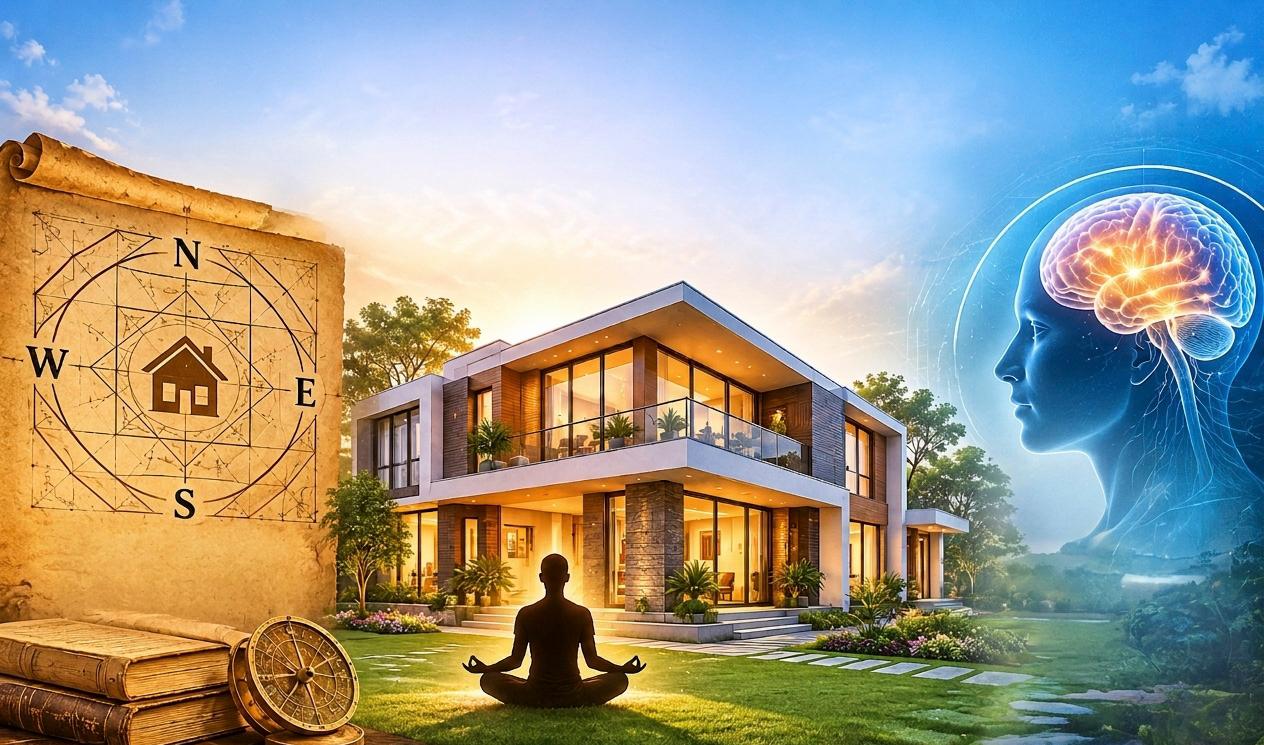
Introduction: Does the Space Around Us Influence the Way We Live?
Have you ever entered a room and immediately felt comfortable, relaxed, or peaceful? Have you also experienced spaces that make you feel uncomfortable, distracted, or restless without knowing exactly why?
These everyday experiences raise an important question: Can the physical environment around us influence our emotions, behavior, concentration, and overall well-being?
Modern environmental psychology explores the relationship between human beings and their surroundings. It examines how light, ventilation, temperature, colours, spatial arrangements, noise, and access to nature influence human experiences.
Interestingly, ancient Indian Vastu Shastra also places considerable importance on the relationship between buildings, directions, natural elements, and human life.
Although Vastu Shastra and environmental psychology developed in very different historical and intellectual contexts, their areas of interest offer an opportunity for meaningful interdisciplinary research.
The question is not whether every traditional Vastu principle has already been scientifically established. Rather, it is whether some of its underlying spatial observations can be examined through modern scientific methods.
The Scientific Importance of the Built Environment
A building is not simply a physical structure. It is an environment in which people sleep, work, communicate, make decisions, and spend a significant part of their lives.
Research in environmental psychology and building science indicates that indoor environmental conditions can influence human comfort and well-being.
Some important factors include:
Natural Light: Daylight affects visual comfort and is relevant to the regulation of human circadian rhythms. The availability, intensity, and timing of natural light deserve attention in residential and workplace design.
Ventilation and Indoor Air Quality: Poor ventilation and inadequate indoor environmental conditions can affect comfort and health. Fresh-air provision is therefore an important consideration in building design.
Noise and Privacy: Unwanted noise can disturb sleep, concentration, communication, and psychological comfort.
Spatial Organization: The arrangement of rooms, furniture, movement pathways, and activity zones can influence how people interact with their surroundings.
Connection with Nature: Views of trees, gardens, and natural landscapes may contribute to psychological restoration and well-being.
These factors provide a practical scientific foundation for examining the relationship between architecture and human experience.
Vastu Shastra and Its Relationship with Environmental Psychology
Vastu Shastra is an ancient Indian architectural knowledge system that discusses the planning and organization of residential and other built spaces.
Its traditional framework includes directions, spatial divisions, natural elements, room placement, proportions, and the relationship between buildings and their surroundings.
Environmental psychology, on the other hand, studies how physical surroundings influence human perception, emotions, and behaviour.
There are several areas where these two knowledge systems can be examined together.
For example:
The traditional importance of sunlight can be studied through daylight measurements and circadian lighting research.
The importance of open spaces can be examined through spatial perception and environmental comfort.
The relationship between natural elements and human well-being can be studied through biophilic design.
Traditional room-placement principles can be investigated through movement patterns, privacy, ventilation, and functional efficiency.
Such comparisons should be treated as research questions rather than proof that every traditional prescription is scientifically correct.
This distinction is essential for developing a credible scientific understanding of Vastu Shastra.
Can Natural Light Influence Human Behaviour?
Light is one of the most important environmental factors in building design.
The human body follows biological rhythms that respond to patterns of light and darkness. The built environment can influence the timing and quality of light exposure.
A room receiving appropriate daylight may provide better visual comfort and a stronger connection with outdoor conditions than a poorly illuminated space.
Research has also investigated the relationship between window views, daylight, occupant perception, and well-being.
A 2022 critical review published in Building and Environment examined 76 studies concerning occupants' responses to window views, daylighting, and lighting. It highlighted the importance of examining these environmental features while also identifying differences and limitations in existing research.
This provides an interesting direction for studying traditional Vastu recommendations concerning the orientation and arrangement of residential spaces.
However, daylight exposure depends on geographical location, climate, building design, surrounding structures, and seasonal variation. Therefore, a single directional prescription cannot automatically be considered universally optimal.
The Psychological Value of Nature and Open Spaces
One interesting area of overlap between Vastu-related spatial concepts and modern environmental psychology is the importance of natural surroundings.
Trees, gardens, vegetation, natural views, and outdoor connections can contribute to the quality of the indoor environment.
A 2025 meta-analysis published in BioScience examined 28 studies covering 104 results concerning the relationship between viewing nature through windows and human health. The findings indicated generally positive associations across several psychological, physiological, and physical health measures.
This research offers an important perspective: the experience of a building is not limited to its walls, doors, and rooms. What people see and experience beyond those walls may also matter.
Traditional architectural ideas concerning open spaces and natural surroundings can therefore be investigated through contemporary research on biophilic design and environmental restoration.
A Scientific Framework for Examining Vastu Principles
If Vastu Shastra is to develop as a scientifically investigated discipline, its principles must be examined using measurable variables and reproducible research methods.
A possible interdisciplinary framework could include the following dimensions:
Directional orientation: solar exposure and daylight
Room arrangement: spatial functionality and movement
Open spaces: ventilation and environmental comfort
Water elements: humidity and moisture conditions
Natural surroundings: visual connection with nature
Bedroom placement: sleep environment and noise
Building proportions: spatial perception and usability
Researchers could study residential buildings with different spatial configurations and examine measurable environmental conditions.
For example, a residential study could record:
Indoor temperature and relative humidity.
Carbon dioxide concentration and ventilation indicators.
Natural light intensity at different times.
Noise levels in different rooms.
Occupants' subjective comfort and satisfaction.
Sleep quality and daily activity patterns, where appropriate.
Data could then be analysed to identify associations between environmental conditions and occupants' experiences.
Importantly, studies should account for socioeconomic conditions, age, occupation, climate, building materials, lifestyle, and other possible confounding variables.
A scientific conclusion should be based on measured evidence rather than assumptions or isolated experiences.
Why Traditional Knowledge Needs Modern Scientific Investigation
Ancient knowledge systems deserve neither automatic acceptance nor automatic rejection.
Their principles should be examined carefully, especially when they make claims concerning human health, financial outcomes, relationships, or psychological conditions.
Some traditional architectural recommendations may have practical environmental explanations. Others may be symbolic, cultural, philosophical, or still awaiting systematic investigation.
Modern science provides tools to distinguish between these possibilities.
For example, a recommendation concerning room orientation can be examined through solar geometry, climate-responsive architecture, and daylight analysis.
Similarly, a recommendation concerning open spaces can be evaluated through ventilation, visual comfort, and environmental psychology.
This approach allows traditional knowledge to become a source of research questions without treating historical statements as established scientific laws.
Towards an Evidence-Based Approach to Vastu Science
The future of Vastu research should involve collaboration among architects, environmental psychologists, building scientists, engineers, and researchers of traditional Indian knowledge.
Three important steps can help advance this objective.
First: Measurement
Traditional architectural recommendations should be translated into measurable environmental parameters wherever possible.
Second: Comparative Research
Researchers should compare different building configurations under similar climatic and geographical conditions.
Third: Independent Validation
Findings should be tested through larger samples, transparent research methods, appropriate statistical analysis, and independent replication.
Such an approach could help identify which traditional principles have measurable environmental relevance, which require modification, and which lack sufficient supporting evidence.
Conclusion: From Ancient Spatial Knowledge to Scientific Understanding
The relationship between human beings and their surroundings is an important subject of scientific investigation.
Environmental psychology and modern building science demonstrate why factors such as daylight, ventilation, noise, spatial organisation, and natural views deserve attention in architectural planning.
Vastu Shastra offers another historical framework through which the relationship between buildings and human life can be explored.
The opportunity lies in bringing these perspectives together without confusing traditional belief with scientific evidence.
Rather than asking people to accept every Vastu recommendation without question, researchers should encourage measurement, experimentation, comparison, and independent validation.
The ultimate objective should be to develop healthier, more comfortable, functional, and environmentally responsive living spaces.
Ancient knowledge can inspire scientific questions. Scientific investigation must determine which answers withstand evidence.
Sources
- Vasquez, N. G., Rupp, R. F., Andersen, R. K., & Toftum, J. (2022). Occupants’ responses to window views, daylighting and lighting in buildings: A critical review. Building and Environment, 219, 109172doi.org
- Health benefits of viewing nature through windows: A meta-analysis. (2025). BioScience, 75(8), 628–636doi.org
- The relationship between buildings and health: A systematic review. (2018). Journal of Public Healthdoi.org
- Image Creditchatgpt.com
Enjoyed this? Get new stories in your inbox.
One email on Mondays with the week's new stories. Free, and one click to unsubscribe.
About the writer

Researcher
My name is Avdhesh Kumar, and my pen name is Acharya Pt Dr Avdhesh Kumarr. I am an independent researcher, author and scientific spiritual researcher based in India. I hold postgraduate qualifications in English and Economics, along with an MBA in Human Resource Management and an honorary doctorate for my contributions to Vastu Science, Numerology and Paranormal Research. My research interests include Vastu Science, Indian Knowledge Systems, Hindu Scriptures, Numerology, Indian Spirituality, Environmental Psychology and Paranormal Studies. With more than 100 research papers and approximately 70 e-books to my credit, I focus on exploring traditional Indian knowledge through research-oriented, analytical and interdisciplinary approaches. I am open to commissioned book projects, paid writing assignments, research-based articles, long-form essays and editorial collaborations. My objective is to connect India's traditional wisdom with contemporary scientific, psychological, cultural and social perspectives.
Writes about Research, Culture, Science, Education