
Gemstones and Traditional Knowledge: A Scientific Perspective
Exploring the relationship between Indian Ratna Shastra, mineral science, human psychology and the evidence surrounding gemstone therapy

4 min read
Introduction
Gemstones have fascinated human civilization for thousands of years because of their beauty, rarity, colours, and distinctive physical properties. In Indian tradition, gemstones hold a special place in Jyotisha and Ratna Shastra, where different stones are associated with planetary influences and human well-being.
However, an important question arises: Can traditional beliefs about gemstones be explained through modern science? An interdisciplinary examination of mineralogy, physics, psychology and traditional knowledge can help explore this question objectively.
Gemstones in Ancient Indian Knowledge
Indian literature contains significant references to gemstones and their traditional classifications. The Brihat Samhita, written by Varahamihira, discusses gemstones in its eightieth chapter, known as Ratna Pariksha. It describes their characteristics, varieties, quality and traditional significance.
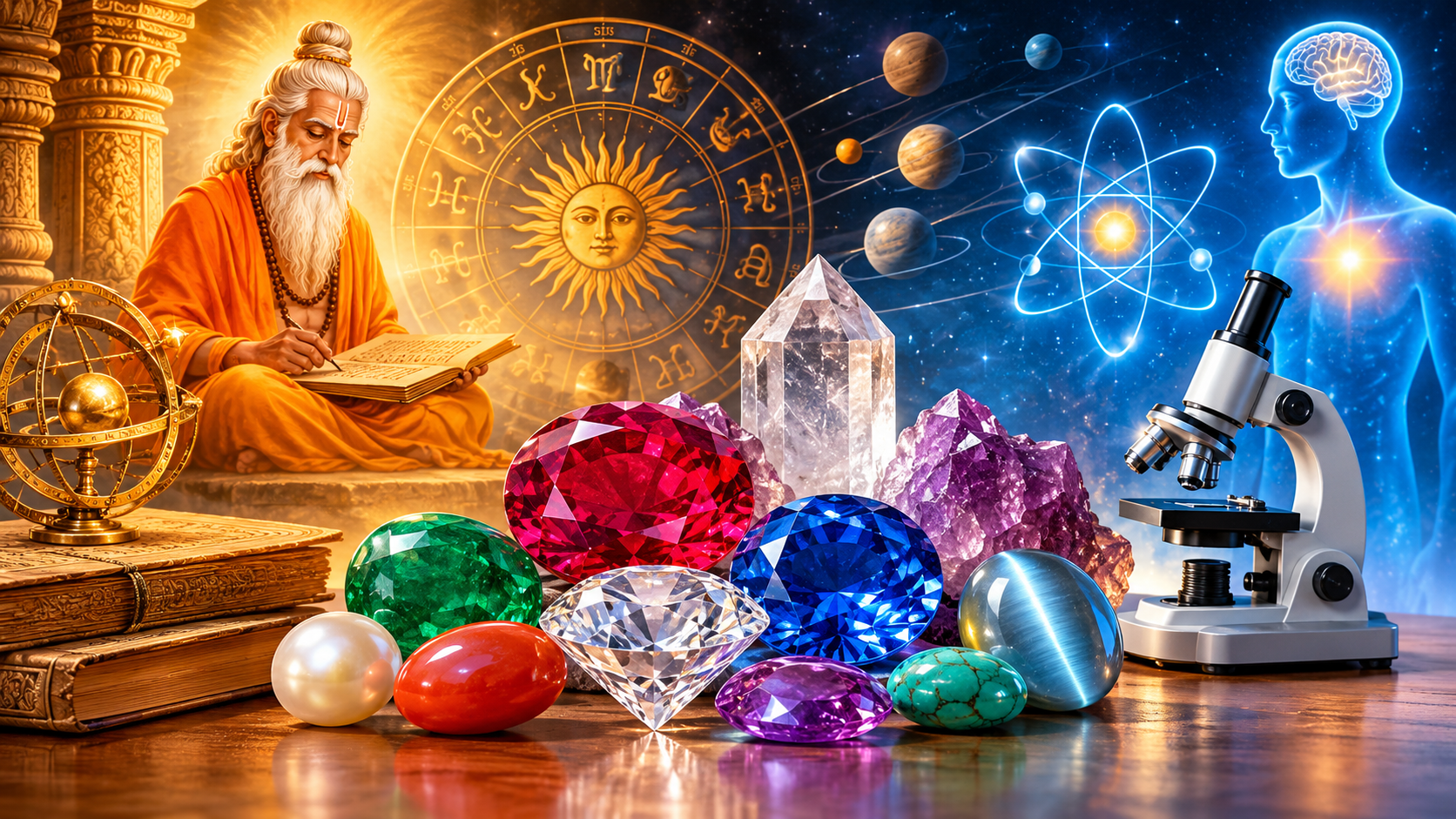
In Indian astrology, nine principal gemstones are traditionally associated with the Navagraha. Ruby is associated with the Sun, pearl with the Moon, red coral with Mars, emerald with Mercury, yellow sapphire with Jupiter, diamond with Venus, blue sapphire with Saturn, hessonite with Rahu and cat's eye with Ketu.
These associations represent an important part of India's traditional knowledge. However, historical and cultural significance should be distinguished from scientifically established effects.
Scientific Properties of Gemstones
Modern mineralogy provides a scientific foundation for understanding gemstones. Their characteristics depend on chemical composition, crystal structure and geological formation.
Some important properties include:
Hardness: Resistance to scratching, measured using the Mohs scale.
Refractive index: The extent to which light changes direction inside a material.
Crystal structure: The arrangement of atoms within a crystalline substance.
Specific gravity: The relative density of a gemstone.
Optical properties: Colour, transparency, dispersion and light absorption.
For example, diamond has a Mohs hardness of 10, sapphire has a hardness of 9 and quartz has a hardness of 7. These measurable characteristics help identify and classify gemstones.
Their colours and brilliance result from interactions between light and the material's chemical composition and internal structure.
Gemstones, Light and Physical Interactions
One interesting area of gemstone research concerns the interaction between light and crystalline materials.
When light enters a gemstone, it may undergo reflection, refraction, absorption and dispersion. These processes contribute to the distinctive appearance of different gemstones.
Quartz also demonstrates an established physical property known as the piezoelectric effect. Under suitable conditions, mechanical stress produces an electrical charge in the crystal. This property has practical applications in electronic devices and frequency-control systems.
However, the existence of electrical or optical properties does not automatically establish that wearing a gemstone produces therapeutic effects in the human body. Such claims require separate experimental investigation.
Gemstones and Human Psychology
The relationship between gemstones and human well-being may also be examined through psychology.
Colors, personal beliefs, cultural associations and individual expectations can influence emotional experiences. A person who associates a particular gemstone with confidence, protection or prosperity may experience reassurance when wearing it.
Such responses may involve expectation, personal meaning and psychological conditioning.
These experiences deserve consideration, but they do not necessarily demonstrate that the gemstone has an independent biological or therapeutic effect.
Understanding the relationship between physical objects, cultural beliefs and psychological responses offers an interesting opportunity for interdisciplinary research.
Scientific Evidence on Gemstone Therapy
Scientific evaluation of gemstone therapy requires controlled experiments rather than relying exclusively on personal experiences.
Christopher French and colleagues presented research at the British Psychological Society's Centenary Annual Conference in 2001 examining reported sensations associated with genuine and imitation quartz crystals. The findings did not establish a specific effect of genuine crystals beyond expectations and placebo-related responses.
A 2025 controlled investigation by Escolà-Gascón and colleagues involving rose quartz also examined claims of anxiety reduction. It did not establish a specific therapeutic advantage attributable to the genuine gemstone.
These findings emphasise the importance of distinguishing subjective experiences from scientifically demonstrated therapeutic effects.
Currently, there is insufficient reliable scientific evidence to establish that wearing gemstones can independently cure diseases or reliably produce specific medical outcomes. Gemstones should never replace established medical treatment.
Towards Interdisciplinary Gemstone Research
Traditional Ratna Shastra and modern science can be examined together through systematic research.
Some important research questions include:
Do different gemstone colours influence mood and attention?
Can wearing gemstones produce measurable physiological changes?
How do personal beliefs and expectations influence reported experiences?
Are observed effects attributable to physical properties or psychological factors?
Can controlled experiments distinguish natural gemstones from visually identical imitations?
Future investigations could compare natural gemstones, visually matched imitation stones and inert control materials using randomisation, blinding and standardised measurements.
Such studies may help distinguish established physical phenomena from psychological responses and unverified therapeutic claims.
Conclusion
Gemstones represent an interesting intersection of natural science, traditional knowledge, cultural heritage and human psychology.
Their physical and optical properties are scientifically established, while their significance in Indian traditions is documented in classical literature such as the Brihat Samhita. However, claims concerning planetary influences and therapeutic effects require further rigorous investigation.
The objective should neither be to reject traditional knowledge automatically nor to accept every traditional claim without examination. Instead, individual claims should be evaluated through appropriate scientific methods.
An interdisciplinary approach can help preserve India's traditional knowledge while encouraging evidence-based research. This may create new opportunities for understanding gemstones and their relationship with human perception and well-being.
Sources
- Varahamihira. Brihat Samhita, Chapter 80: Ratna Pariksha (On Gems). English translation by N. Chidambaram Iyer (1884).wisdomlib.org
- U.S. Geological Survey. Natural Gemstones – Mineral Gemstones. Information on gemstone hardness, specific gravity and mineral compositionpubs.usgs.gov
- Uchino, K. (2021). Fundamentals of Piezoelectrics. Encyclopedia of Smart Materials, Elsevierdoi.org
- Escolà-Gascón, Á., Dagnall, N., Drinkwater, K., Denovan, A., & Benito-León, J. (2025). Placebo Effects in Alternative Medical Treatments for Anxiety: False Hope or Healing Potential? CNS Spectrums, 30(1), e70doi.org
- French, C. C., O'Donnell, H., & Williams, L. (2001). Hypnotic Susceptibility, Paranormal Belief and Reports of 'Crystal Power'. Proceedings of the British Psychological Society, 9(2), 186. Conference presentation.skeptic.org.uk
Enjoyed this? Get new stories in your inbox.
One email on Mondays with the week's new stories. Free, and one click to unsubscribe.
About the writer

Researcher
My name is Avdhesh Kumar, and my pen name is Acharya Pt Dr Avdhesh Kumarr. I am an independent researcher, author and scientific spiritual researcher based in India. I hold postgraduate qualifications in English and Economics, along with an MBA in Human Resource Management and an honorary doctorate for my contributions to Vastu Science, Numerology and Paranormal Research. My research interests include Vastu Science, Indian Knowledge Systems, Hindu Scriptures, Numerology, Indian Spirituality, Environmental Psychology and Paranormal Studies. With more than 100 research papers and approximately 70 e-books to my credit, I focus on exploring traditional Indian knowledge through research-oriented, analytical and interdisciplinary approaches. I am open to commissioned book projects, paid writing assignments, research-based articles, long-form essays and editorial collaborations. My objective is to connect India's traditional wisdom with contemporary scientific, psychological, cultural and social perspectives.
Writes about Research, Culture, Science, Education