
Own a Building in Pieces? Inside India’s Property Tokenisation Push
Digital ledgers could let ordinary investors own a slice of offices and warehouses. India is building the rules first. Here’s what’s real, what’s still a pilot, and what to check before you invest.

6 min read
For most Indian families, buying property means saving for decades, taking a 20-year home loan and putting most of their wealth into a single flat. Commercial real estate, the Grade A offices and warehouses that earn steady rent, has long been out of reach for anyone without crores to invest.
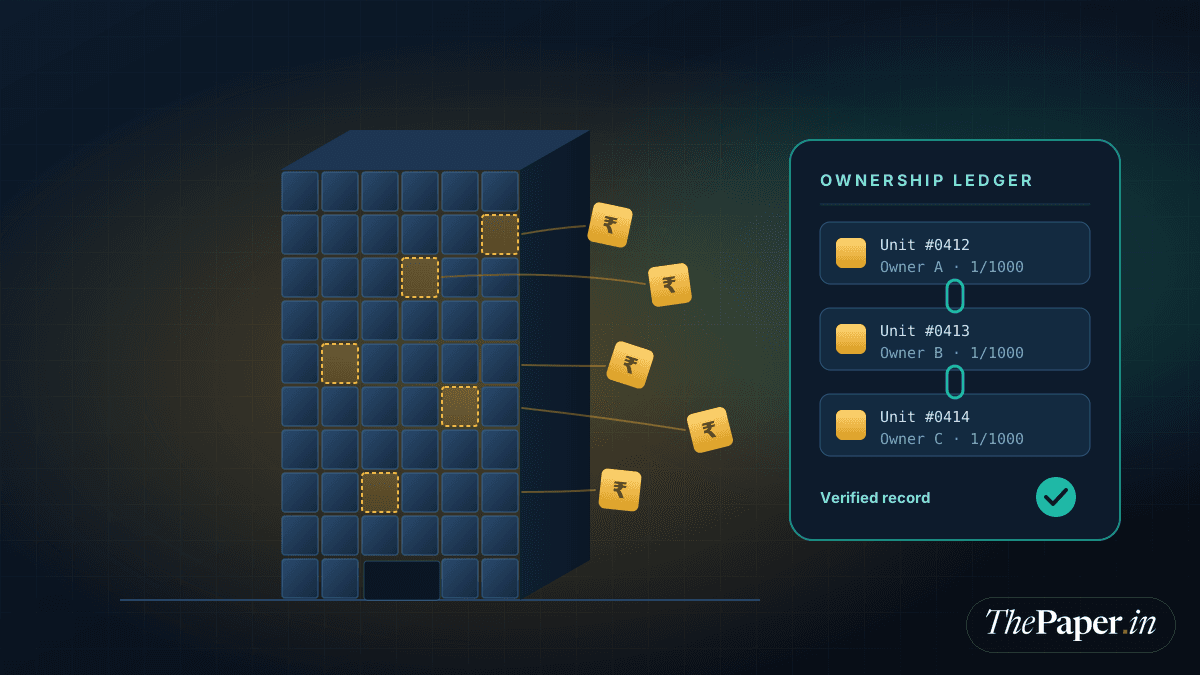
A new idea promises to change that: split a building into thousands of small digital units, record who owns each one on a secure digital ledger, and let ordinary investors buy and sell them as easily as shares. It is called tokenisation. India is moving towards it carefully, building the rules first, and that caution is something investors should understand before they put money in.
What is property tokenisation?
Tokenisation turns ownership of a real asset into digital units, or “tokens”, recorded on a shared ledger, often a blockchain. Each token represents a fixed share of the asset and its income.
Picture an office building worth ₹100 crore. Instead of one buyer, it could be divided into one lakh tokens of ₹10,000 each. Token holders would receive their share of the rent, and the ledger would show at any moment who owns what. Supporters say this could make property investing cheaper, more transparent and easier to exit, since selling a token is simpler than selling a building.
The idea is simple. Making it legally safe is not. In India, property ownership is governed by state land laws, stamp duty and the Registration Act, and none of these were written with digital tokens in mind.
The regulated route available today: SM REITs
The closest thing Indian retail investors can access today is not a blockchain token but a new regulated product. In March 2024, the Securities and Exchange Board of India (SEBI) notified rules for Small and Medium Real Estate Investment Trusts, or SM REITs. They partly aim to bring fractional ownership platforms, which had grown quickly with limited oversight, under SEBI’s supervision.
Under the SM REIT framework, schemes can hold assets worth ₹50 crore to ₹500 crore, the minimum investment is ₹10 lakh, units must go to at least 200 investors, and at least 95% of the assets must be completed, income-generating properties. Units are listed on stock exchanges, and schemes must distribute 95% of their earnings to investors.
The market has started to take shape. Property Share became the first firm to receive an SM REIT licence. Its first scheme, PropShare Platina, raised ₹353 crore in November 2024. Its second, PropShare Titania, a ₹473-crore issue for fully occupied office space in Thane, opened in July 2025 with a minimum ticket of about ₹10 lakh.
That ticket is still high for most households, but it is far lower than buying commercial property directly, and investors get SEBI’s disclosure rules and a listed, tradable unit in return.
GIFT City: the testing ground
True blockchain tokenisation is being tested in a controlled setting at GIFT City in Gujarat, India’s international financial services centre. Its regulator, the International Financial Services Centres Authority (IFSCA), has run a regulatory sandbox where firms can trial new products under close watch.
In late 2023, Terazo, a fintech set up by the team behind real estate developer Collated, said it was part of the GIFT City sandbox and planned to tokenise real estate on the Polygon blockchain, with investments structured through a GIFT City alternative investment fund. The focus is largely on attracting foreign investors, so these products are not a route for ordinary resident Indians to buy property tokens at home.
The RBI is building the plumbing
While property tokens stay in the sandbox, the Reserve Bank of India is building infrastructure that could one day support them. At Global Fintech Fest 2025, the RBI Governor announced the Unified Markets Interface (UMI), a platform for tokenising financial assets, with settlement in the wholesale digital rupee.
The RBI’s annual report for 2025-26, released in May, said the central bank had launched a pilot to issue and trade certificates of deposit in tokenised form on UMI. Certificates of deposit are not property, but the pilot tests the core technology: digital ownership records, instant transfers and settlement in central bank money. Once that works safely for simple instruments, it could be extended to more complex ones.
Fixing the foundation: land records
Tokens are only as reliable as the ownership records behind them. If the title to a building is disputed, a token representing a slice of it is disputed too.
This is where the government’s land records push matters. The Digital India Land Records Modernisation Programme is digitising records and giving land parcels a 14-digit Unique Land Parcel Identification Number, popularly called Bhu-Aadhaar.
The Supreme Court has also weighed in. In Samiullah v State of Bihar, decided in November 2025, a bench of Justices P.S. Narasimha and Joymalya Bagchi noted that property disputes make up an estimated 66% of all civil cases. The court observed that blockchain’s immutability “could enhance the integrity of title records” and asked the Law Commission to examine how property registration and conclusive titling could be modernised, including through blockchain with safeguards.
The risks investors should know
Because the regulated market is still small, many products marketed as “fractional ownership” or “tokenised property” fall outside SEBI’s framework. That gap has caused problems. In May 2025, SEBI cautioned investors after Strata, which had received an SM REIT licence in January, surrendered its registration while its co-founder faced a legal dispute. Strata said it surrendered the licence voluntarily and without admitting wrongdoing. SEBI said Strata had not launched any SM REIT schemes and would not present itself as a SEBI-regulated entity.
Other risks to keep in mind:
- Liquidity: a token or unit can be hard to sell if few buyers exist.
- Legal title: if the underlying ownership structure is weak, so is your investment.
- Valuation: property values and rents can fall, and the stated yield is not guaranteed.
How to invest safely
- Check SEBI registration on SEBI’s website before investing in any SM REIT or fractional platform.
- Prefer listed units that trade on a stock exchange.
- Read the offer document, especially details on tenants, lease periods and fees.
- Be wary of crypto-style property tokens sold directly to Indian residents through apps or social media.
- Don’t over-concentrate. Real estate should be one part of a diversified portfolio.
The bottom line
Tokenisation could one day make property investing as simple as buying a mutual fund. India is getting there step by step: SEBI-regulated SM REITs for retail investors today, sandbox trials in GIFT City, RBI pilots on the digital rupee and a long-term push to clean up land records. For investors, the message is simple. The technology is promising, but the safest slice of a building is still the one sold under a regulator’s eye.
This article is for information only and is not investment advice. Consult a SEBI-registered adviser before investing.
Sources
- AMLEGALS: SEBI SM REIT frameworkamlegals.com
- Business Standard: PropShare Titania ₹473-crore SM REIT IPObusiness-standard.com
- Morung Express (IANS): RBI starts tokenised CD pilotmorungexpress.com
- Outlook Money: SEBI cautions investors on Strataoutlookmoney.com
- Ledger Insights: Regulated asset tokenisation in GIFT Cityledgerinsights.com
- Vajiram & Ravi: RBI Unified Markets Interfacevajiramandravi.com
- Verdictum: Samiullah v State of Biharverdictum.in
About the writer

A Publishing Network
ThePaper is a publishing network where journalists, writers, researchers and creators publish their work, build their reputation and get discovered by publishers.
Writes about Journalism, Technology, AI, Business