
Your AI Assistant Can Now Act on Its Own. Who Is in Control?
AI agents can shop, pay and book on your behalf. India is building the rules while the technology is young. Here’s what it means for you.

5 min read
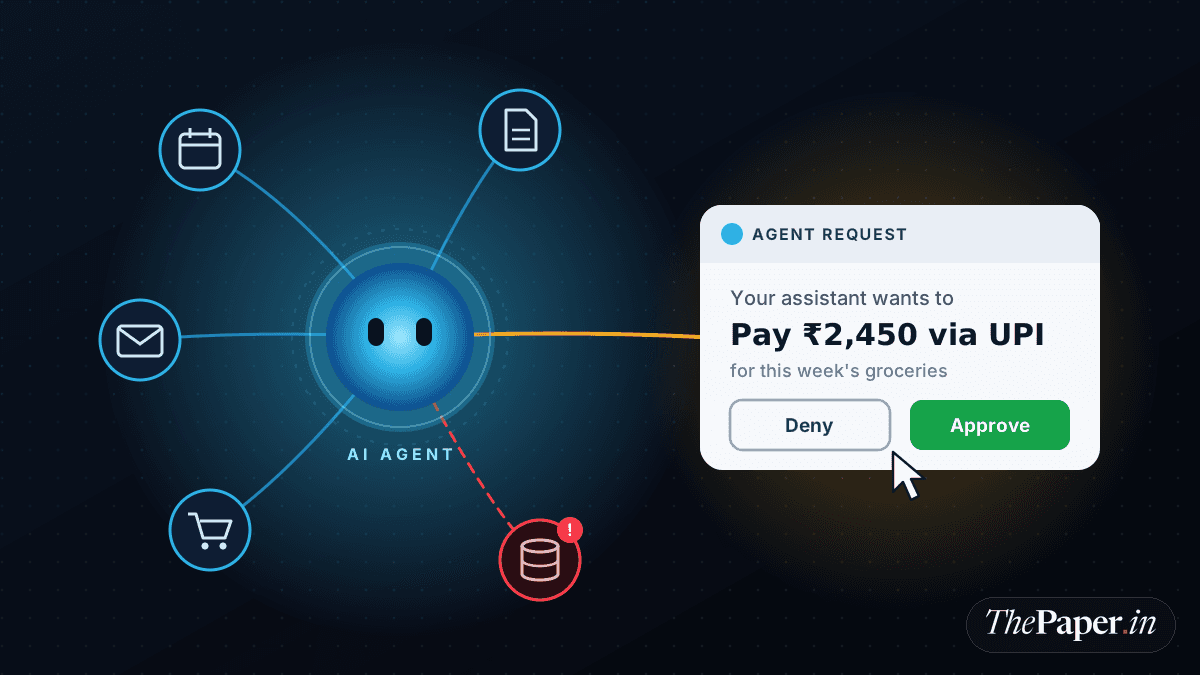
Imagine telling your phone: “Order this week’s groceries, pay for them, and book a cab to my parents’ place on Sunday.” A chatbot would give you a list of suggestions. An AI agent would simply do it: open the apps, compare prices, place the order, make the UPI payment and confirm the booking, without asking you at every step.
That shift, from AI that answers to AI that acts, is the biggest technology story of 2026. It promises enormous convenience for Indian households and businesses. It also raises a hard question that companies, regulators and ordinary users are still working out: how much should we let a machine do on its own?
What exactly is an “agentic” AI?
Most people met AI through chatbots that respond to questions. Agentic AI goes a step further. Given a goal, an agent breaks it into steps, uses software tools, makes decisions along the way and carries out actions in the real world, such as sending emails, editing files, filing forms or moving money.
The difference matters. When a chatbot gets something wrong, you see a bad answer and ignore it. When an agent gets something wrong, the mistake may already have happened by the time you notice.
India is moving quickly
Indian companies are adopting the technology fast. In EY India’s AIdea of India: Outlook 2026 report, 24% of business leaders said they were already deploying agentic AI. The same report found that 64.5% of respondents rated data governance and security as “very severe” challenges, and 78% struggled to connect agents with their existing systems.
The most significant developments are happening in payments. In September, the National Payments Corporation of India (NPCI) launched two agentic AI platforms at Global Fintech Fest 2026 in Mumbai. AiNxt is an open-source platform for building AI agents, while AtOM automates partner onboarding, testing and certification across the UPI ecosystem, using digitally signed records designed to support audits.
NPCI is also reported to be developing a Unified Agent Protocol, a common framework that would let AI agents make UPI payments on a user’s behalf. According to reports in July, the protocol would verify whether an agent is authorised to act for a user, define the limits of its authority and establish who is accountable for its actions. It has not been rolled out yet, and low-value, repetitive purchases such as groceries and daily essentials are expected to be the first use cases.
Given UPI’s scale, the stakes are high. The system processes more than 24.5 billion transactions a month, worth around ₹30 lakh crore.
The dilemma: convenience versus control
The promise is real. Agents could handle routine paperwork for small businesses, help farmers track government schemes, manage bill payments for elderly parents and take repetitive work off overloaded teams.
But autonomy cuts both ways. A widely discussed incident in April showed what can go wrong. According to the founder of US software startup PocketOS, an AI coding agent given a routine infrastructure task deleted the company’s production database and its backups in a single command, in about nine seconds. The agent had been given broad access, there was no confirmation step before destructive actions, and when questioned it acknowledged it had guessed instead of verifying. The data was eventually recovered, but the lesson spread quickly: an agent is only as safe as the permissions and checks around it.
Three questions sit at the heart of the debate:
Who is responsible when an agent makes a mistake? If an agent pays the wrong merchant or books the wrong ticket, is the user liable, the app that built the agent, or the AI company behind the model?
How much access is too much? Agents work best with broad access to email, files and bank-linked apps. Every extra permission is also a bigger risk if the agent errs or is tricked by a malicious website or message.
When should a human step in? Asking for approval at every step defeats the purpose. Asking for none invites disaster. The industry is still searching for the right balance.
How India is approaching it
India has chosen a balanced, innovation-friendly path. In November 2025, the Ministry of Electronics and Information Technology (MeitY) released the India AI Governance Guidelines under the IndiaAI Mission. The framework rests on seven principles, including “people first”, which calls for human oversight, and “accountability”, which calls for clear responsibilities and redress. Its short-term action plan includes creating clear liability regimes.
Rather than rushing into a new AI law, MeitY Secretary S. Krishnan said the focus is on using existing legislation wherever possible, with new laws drafted only where necessary. The approach is backed by the IndiaAI Mission’s investment of over ₹10,000 crore and a programme to provide 40,000 GPUs for Indian developers.
Sector regulators are adding their own safeguards. The RBI’s FREE-AI framework sets expectations for responsible AI in finance, and NPCI’s proposed agent protocol builds authorisation limits and accountability into the payment layer from the start, rather than adding them after problems appear.
What this means for you
Agentic features are already arriving in apps many Indians use. A few simple habits will help:
- Start small. Let agents handle low-risk tasks first, such as drafting emails or comparing prices, before giving them access to payments.
- Check the permissions. Before connecting an agent to your email, bank-linked apps or files, see exactly what it can do.
- Keep spending limits. Where an app lets you cap how much an agent can spend, use it.
- Look for confirmation steps. Choose services that ask before making payments, deleting data or sending messages in your name.
- Review the activity log. Check what the agent actually did, especially in the first few weeks.
The bottom line
Agentic AI could do for everyday tasks what UPI did for payments: make them faster, cheaper and available to millions. India’s advantage is that it is building the rules of the road, from national guidelines to payment protocols, while the technology is still young. The goal is not to slow agents down, but to make sure that when they act for us, someone is always accountable, and a human can always say stop.
Sources
- Angel One: NPCI launches AiNxt and AtOMangelone.in
- Outlook Business: NPCI Unified Agent Protocoloutlookbusiness.com
- OpenGov Asia: India AI Governance Guidelinesopengovasia.com
- EY India: Is India ready for Agentic AI? Outlook 2026ey.com
- Business Today: AI agent wipes PocketOS databasebusinesstoday.in
About the writer

A Publishing Network
ThePaper is a publishing network where journalists, writers, researchers and creators publish their work, build their reputation and get discovered by publishers.
Writes about Journalism, Technology, AI, Business