
“You Are Under Digital Arrest”: Inside India’s ₹4,000-Crore Scam
Fake police, forged court orders and video calls that last for days. Here’s how the scam works, and how to protect your family.

6 min read
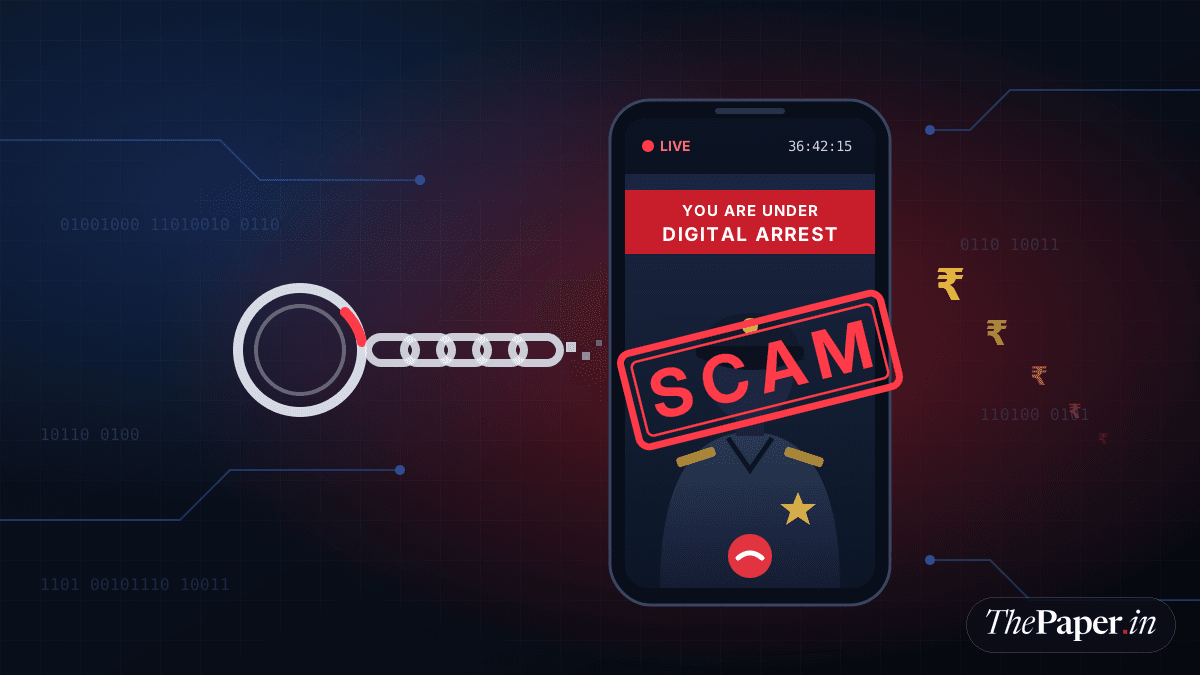
The call usually starts with something ordinary: a parcel held at customs, a SIM card misused in your name, a bank account linked to money laundering. Within minutes, the caller has “transferred” you to a man in a police uniform on a video call. There’s a badge, an official-looking backdrop, perhaps even a document with a Supreme Court seal. You are told you are under “digital arrest”, that you must stay on camera, tell no one, and transfer your savings for “verification”.
None of it is real. But the losses are.
What exactly is a “digital arrest”?
The first thing every Indian should know: there is no such thing in law. No agency in India, whether the CBI, ED, NCB, police, or customs, can arrest you over a phone or video call.
The scam is a form of cyber fraud in which criminals impersonate law-enforcement agencies to extort money by creating fear and urgency. They falsely link victims to criminal cases and threaten arrest or freezing of bank accounts using spoofed numbers and fake documents, then pressure them into paying a fake fine or “security deposit”.
What makes it different from older phone frauds is the psychological pressure. Victims are forced to remain on continuous video or audio calls, often for hours or days, cut off from family members who might spot the trick.
A typical case from this year shows how polished the script has become. In Mangaluru, a 66-year-old lost ₹34.48 lakh to fraudsters posing as officials from the Data Protection Board of India and the Mumbai Police. The caller claimed someone had fraudulently obtained a SIM card using the victim’s ID and used it for illegal activities, then warned that a Supreme Court arrest warrant had been issued.
The scale of the problem
Government figures show how quickly this fraud spread. Between 2022 and May 2026, authorities recorded 2,97,727 complaints and losses worth ₹4,057.7 crore. Senior citizens are often the prime targets, coerced into making large RTGS transfers. In one widely reported case, an elderly NRI doctor couple from Delhi lost ₹14.84 crore.
The good news is that the trend has turned. According to the Indian Cyber Crime Coordination Centre (I4C), digital-arrest complaints fell sharply from 1,23,672 in 2024 to 58,249 in 2025 and 16,377 by June 2026. Officials credit rising public awareness. Still, the first five months of 2026 alone saw losses worth ₹481.1 crore, so the threat is far from over.
Who is behind it?
These are not lone tricksters. They are organised, cross-border syndicates. The Attorney General told the Supreme Court that money laundering networks, largely based outside India, are behind these scams, with many gangs located in parts of Asia, including Myanmar and Thailand.
There is a darker twist: many of the people making these calls are themselves victims. Criminal syndicates run highly sophisticated “scam compounds” in Cambodia, Myanmar and Laos staffed with thousands of people, many from India, lured with fake job offers and then forced to scam people back home. Rescued workers have described being coerced into signing one-year contracts and made to run frauds ranging from fake investment schemes to digital arrest scams.
India has mounted a large rescue effort. The Union government told Parliament it rescued 6,998 Indian nationals from cybercrime centres in Cambodia, Myanmar and Laos between 2022 and 2025: 2,533 from Cambodia, 2,297 from Laos and 2,168 from Myanmar. Pressure is also building in the region itself. In November 2025, Myanmar’s military reportedly demolished around 180 buildings at KK Park, a major scam hub on the Myanmar–Thailand border.
How India is fighting back
The response now spans the government, courts, banks and tech platforms.
The Prime Minister’s warning. PM Narendra Modi used his Mann Ki Baat programme to warn citizens about the scam, helping push it into national conversation.
Blocking the tools. I4C has blocked over 3,962 Skype IDs and 83,668 WhatsApp accounts used for digital arrest scams. WhatsApp itself banned 9,400 more accounts in a 12-week crackdown from January 2026.
The Supreme Court steps in. On October 17, 2025, the court took suo motu cognisance after a senior citizen couple from Ambala, Haryana, lost ₹1.05 crore. The fraudsters had shown them forged judicial orders over video calls. The court later asked the CBI to investigate, and the Centre formed a high-level Inter-Departmental Committee to examine all aspects of the problem. In August 2026, the court went further, directing the RBI to issue an SOP within four weeks for temporary debit holds on mule accounts linked to cyber fraud.
Following the money. A Money Restoration Mechanism built on data-sharing between the RBI Innovation Hub and I4C now covers 1,23,590 branches of 69 banks and has restored ₹18.05 crore in 36,290 cases. Meanwhile, the CBI’s Operation Chakra-VI searched 89 locations across 20 states in September, arresting three people allegedly linked to laundering ₹42.4 crore.
The challenge ahead is speed. Money moves through dozens of mule accounts within minutes, and the masterminds sit beyond Indian jurisdiction. Recovery figures remain small compared with total losses, which is why prevention still matters most.
How to protect yourself and your family
Remember the golden rule: No police officer, CBI official, judge or customs officer will ever arrest you, question you or demand money over a video call.
Warning signs of a scam call:
- Claims about a parcel with drugs, a misused SIM card, or your Aadhaar linked to a crime
- Being asked to stay on video and not tell anyone, including family
- Demands to transfer money for “verification”, “clearance” or a “refundable deposit”
- Official-looking documents with court or agency seals sent on WhatsApp
What to do:
- Disconnect immediately. You are not legally required to stay on any call.
- Talk to someone you trust. Scammers depend on isolation. One conversation with a family member usually breaks the spell.
- Verify independently. Call your local police station using a number you find yourself, not one the caller gives you.
- Report fast. Call the national cybercrime helpline 1930 or file a complaint at cybercrime.gov.in. The first few hours matter most for freezing money.
- Report the number. Flag suspicious calls and messages through the Chakshu facility on the government’s Sanchar Saathi portal.
- Talk to your parents and grandparents this week. Elderly people are the most targeted. A five-minute conversation could save a lifetime of savings.
Have you or someone you know received a digital arrest call? Share your experience with ThePaper.in. Your story could help others recognise the warning signs.
Sources
- The ₹4,057.7 crore loss figurenewsbytesapp.com
- The I4C advisorynewstodaynet.com
- The Supreme Court casetheleaflet.in
About the writer

A Publishing Network
ThePaper is a publishing network where journalists, writers, researchers and creators publish their work, build their reputation and get discovered by publishers.
Writes about Journalism, Technology, AI, Business